
Articles
How Language-Rich Interaction and Sensory Play Shapes Infant Brain Development
Over one million neural connections are formed every second during the first three years of a child’s life, making this formative period crucial to lifelong development. One of the most effective ways to support this rapid development? Purposeful, language-rich interactions. When paired with sensory play—like touching different textures, hearing new sounds, or moving through space—these verbal exchanges help babies connect words to meaning, build vocabulary, and develop essential cognitive skills.
However, designing and facilitating a curriculum that supports both sensory exploration and early communication isn’t as simple as it sounds. This article explores how educators are trained to help children unlock their full, all-rounded potential, with insights from the National Institute of Early Childhood Development’s (NIEC) Assistant Director of Faculty & Leadership Development Dr Cynthia Tan as well as Lead Lecturer Ms Karyn Phua. We also hear from NIEC graduates from the Effective Speech for Infant and Early Years Educators programme, Ms Rita Norviani and Ms Adelyn Hang, who share how effective communication strategies support language acquisition and enhance sensory play in young children.
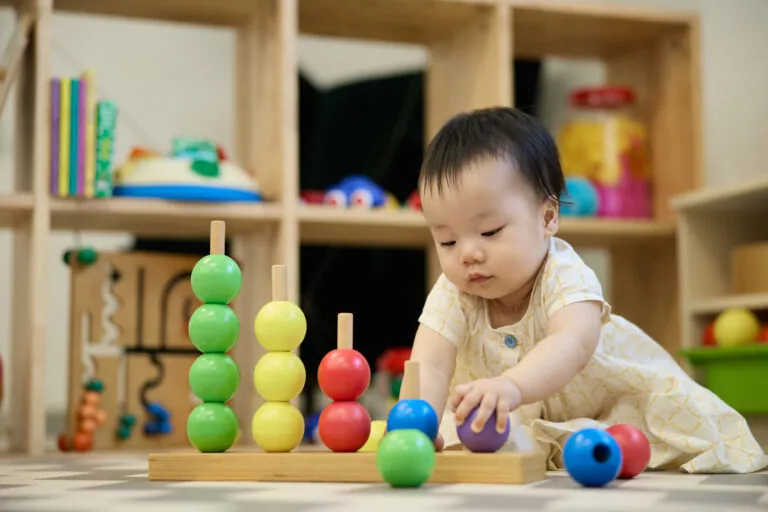
How language and sensory play shape an infant’s understanding of the world
Unlike adults, who rely on verbal instructions, infants learn primarily through their senses. Activities like squeezing a soft sponge, shaking a rattle, or crawling on different surfaces do more than just entertain; they actively strengthen neural connections. Experiencing and exploring the cause and effect of natural phenomena helps babies to understand the logic that drives the world around them.
These sensory experiences can then be converted into meaningful learning moments when combined with speech. For example, an adult may use simple language to describe what a baby is experiencing, such as the texture of a sponge, to establish word association and provide them with words to describe similar experiences in the future.
“When educators use clear, expressive speech to describe what a child is experiencing, they help build vocabulary and comprehension. Babies are well able to understand words even before they can say them!”
Dr Cynthia Tan
What is equally critical, however, is the way we structure our speech. Complex sentences that combine multiple ideas—“This sponge is like the one we used yesterday, except it’s rougher and it soaks up water faster”—can overwhelm a developing brain. Instead, experts suggest breaking up sentences into bite-sized ideas such as “This sponge is rough.” or “It soaks up water.” to make them more easily digestible.
Practical language strategies to support sensory learning
Educators play a crucial role in guiding infants through sensory play, ensuring that these experiences lead to meaningful language development rather than confusion. With proper facilitation, pairing sensory play with intentional speech can significantly accelerate both cognitive and linguistic growth.
1. Songs and rhymes to reinforce speech patterns
Music is a powerful tool for language acquisition, as it naturally introduces rhythm, intonation, and repetition. Simple, repetitive songs like Twinkle, Twinkle, Little Star or The Wheels on the Bus help children anticipate words, making them ideal for language learning. Incorporating hand gestures and movements that match the lyrics further reinforces phonetic patterns, creating an engaging, interactive experience.
“Songs and rhymes help children build their vocabulary and boost their confidence when they can sing and articulate words clearly.”
Ms Adelyn Hang
2. Communicate and interact with intention patterns
The way educators respond to infants can lay the foundation in their emotional and social development. It is important to let children feel seen, heard, and understood via appropriate gestures and facial expressions so that they can build models on how to respond appropriately in social situations. Through consistent and empathetic back-and-forth interactions, children can gain confidence to express their needs and learn important social skills such as turn-taking, active listening, and emotional regulation.
Music is a powerful tool for language acquisition, as it naturally introduces rhythm, intonation, and repetition. Simple, repetitive songs like Twinkle, Twinkle, Little Star or The Wheels on the Bus help children anticipate words, making them ideal for language learning. Incorporating hand gestures and movements that match the lyrics further reinforces phonetic patterns, creating an engaging, interactive experience.
“Young children need repetition, clear pronunciation, and pauses to process what’s being said. When I’m more intentional about how I speak, students listen more and try to mimic my words.”
Ms Rita Norviani
3. Role model communication behaviours
Babies learn by mimicking adults, so creating opportunities for them to imitate not only speech but behaviour as well according to situations is essential. Educators can encourage this by repeating and expanding on children’s attempts at communication through demonstration of speech and actions in a calm and clear manner. This reinforces their attempts by responding in a validating manner.
Creating the ideal environment for sensory learning
Sensory play thrives in environments that encourage exploration, interaction, and routine. That said, a well-designed space alone is insufficient. Educators need to facilitate meaningful engagement with textures, colours, and open-ended scenarios while also providing a sense of security that encourages children to explore.
The key lies in flexibility. While structure is indispensable in establishing patterns and reinforcement, infants and toddlers must be offered autonomy so that they can exercise choice, independence, and freedom of movement. This autonomy is what builds confidence in motor and language decision making.
Equally important are the interactions children have with adults. Language develops through responsive engagement—acknowledging gestures, making eye contact, and expanding on a child’s words all strengthen communication skills. Educators and parents play a shared role in this process. Strong parent-educator partnerships are a key foundation in helping children explore, communicate, and grow.
“Infant and toddler development is a collaborative effort between educators and parents. It requires trust, respect, and open communication to reinforce learning across home and school.”
Ms Karyn Phua
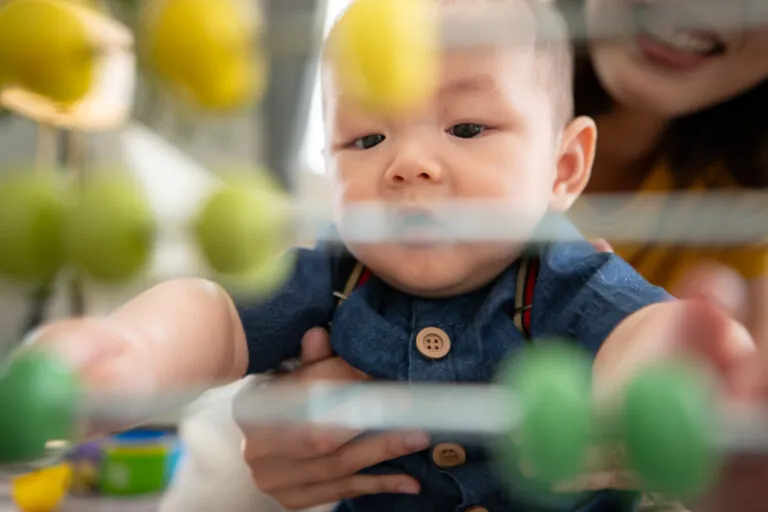
Become an early development specialist to nurture tomorrow’s minds
As educators, we play a crucial role in maximising the first years of a child’s rapid development. This responsibility can be truly impactful when equipped with the right knowledge and skills to facilitate meaningful play. Explore NIEC’s Birth to Three courses and discover how you can contribute to children’s exciting developmental journey by honing your expertise in early childhood development.