
Resources


Dear Educators,
Thank you for joining us at our recent “Embracing Diversity in Early Childhood” Naptime Webinar on 11 July 2025! With Ms Michelle Foo, Lead Lecturer at NIEC, the session explored what diversity means, how it can be reflected in the classroom, and practical tips on supporting children with different needs to create inclusive and welcoming environments for all.
Hear from NIEC’s Director and CEO Ms Geraldine See on the need for diversity and inclusivity in the classrooms in her opening address.
Want to make your classroom inclusive for all?
In this video, Ms Michelle shares more about what diversity looks like in the classroom, and how to care for students with diverse needs.
Still have questions?
Read Ms Michelle’s answers to questions sent in during the Q&A session!
- I work in a Christian church-affiliated preschool, but our children come from non-Christian families. How can we respectfully incorporate other cultural celebrations like Deepavali or Hari Raya?
We talk about HOW they celebrate this festival. Some examples:
– Do they decorate the house? What do they decorate their house during this festivity?
– Does mummy bake or buy festive cookies or goodies?
– Are there any special dishes that are prepared for this festival?
We talk about the clothes they were.
– Is there a special way of showing respect or greeting grandparents, parents or relatives?
– Do you go to the temple? We don’t talk about the religion, but we educate the children with the term used for different places of worship. This promotes culture and teaches diversity in young children.
Because these are cultural celebrations, we focus on the cultural and traditional practices NOT the religious practices.
Think of how our local schools celebrating Racial Harmony Day. What do we do during this day? When we celebrate festivals, we celebrate the cultural and traditional aspects of the festival.
Think of it as celebrating Racial Harmony Day spreading across four days, one day-one culture.
- My centre (also a Christian school) celebrates cultural festivals, but the focus is on the culture, not the religion — is this okay?
Absolutely! That’s the way it should be done. We MUST NEVER touch on the religion. We only delve into the cultural and traditional aspects of the celebration. When we introduce these festivals and children are aware of these differences, we are making them aware of the diversity amongst them…different but still the same in many ways!
- The families in my centre are very shy and passive. What are some ways to encourage them to share their culture, attend centre events, or volunteer?
Share their Culture:
If the families are shy and passive, one way is to get the children to do Show-and-Tell. Have the parents teach the children about an item that they use, eat or wear doing that festival/celebration and have the children present it during their Show-and-Tell session. You might want to video the session for the parents to view the Show-and-Tell or even setup a Zoom session for the parents to log in and view. By watching the Show-and-Tell session, it might encourage and motivate parents to participate the next time you ask for parent involvement in the centre.
Attend Centre Events:
For parents to attend centre events, these events need to be meaningful and relevant to both the child/children and parents. Have Sports Day, let them watch the physical abilities and teamwork in their children and have parent-child games. Or have an exhibition showcasing the children work. This can be done by levels or by classes, it does not have to be the whole centre on the same day.
Volunteer:
Out of all the children, there must be ONE who would be interested to volunteer. Let him/her start, then spearhead a Parent Volunteer Group. If NO one wants to volunteer, then let it be.
What is important is for the centre and teacher to build a strong and positive rapport with the parents. Just like you create a rapport with the children in your class, you need to build it with their parents as well. It starts with YOU! Greatness in teaching isn’t built in a day—it’s earned through dedication, passion, and perseverance. It takes consistent effort, and your reputation as an educator will always speak for itself. When the rapport and trust is established, parents will go to the moon and back for the teachers. Because they know that you have their children at heart. The wellbeing and development of their children always come first before anything else when they have you as their teacher.
I remembered once when I did not have raisins to bake cookies with the children in our K2 class, at 7:30am in the morning, I called one of the mothers who was into baking and cooking. I told her I didn’t have the ingredients, she replied, ‘tell me what you need, how much you need and when you need it and I will bring it for you’.
- How do we explain inclusion and diversity to 4-year-olds?
We DON’T explain inclusion to 4-year-olds. We model it in our class, and we include every child in the activities. Example, if you have to speak slowly for the child to understand and the children ask you WHY you need to speak slowly, simply say that the child does not speak English at home and takes a little longer to understand, just like when Laoshi speaks to some of your friends, they take a little longer to understand the Chinese instructions.
Another example of a child who comforts himself/herself by rocking or spinning, and if the children ask you WHY is he/she like that, you tell the children that Tom/Jane, rocks or spins to feel comfortable, just like you need to bring your toy car when you come to school to feel comfortable OR you need your soft toy when you take a nap because you feel comfortable having it.
When you practice this approach in class, children will come to understand diversity as well. They learn that they are different with different likes and dislikes.
- I have a child who is very disruptive in class. I’ve tried many strategies but still struggle to help him calm down. Any recommendations or resources?
I need more information from your observations of this child to answer this question.
– How often does he do this?
– What does he do when he is disruptive?
– Is he the same at home?
– What causes him to be disruptive?
– When does he NOT act out?
– What strategies have you tried using?
– How long has this behaviour persist? When did this behaviour start?
– If it started before your class, did the previous class teacher observe the same behaviour?
- How do we support a child who does not want to participate in activities and has strong reactions to change? He is already flagged for DSLS, but even therapists can’t enter the room without him crying.
I need more information from your observations of this child to answer this question.
– Is this a transition issue?
– How often does he do this?
– Does this happen all the time or only at certain transitions?
– Is he the same at home?
– What causes him to be resist change?
– When does he NOT act out?
– What strategies have you tried using?
– How long has this behaviour persist? When did this behaviour start?
– If it started before your class, did the previous class teacher observe the same behaviour?
– What is he flagged for in DSLS?
- How can we support children with strong sensory needs who may engage in behaviours that are socially inappropriate in classroom settings?
I need more information from your observations of this child to answer this question.
– What do you mean by strong sensory needs?
– Is this happening at home?
– How do they manage it at home?
– What kind of ‘socially inappropriate behaviours?
– Are these behaviours a danger to themselves and the people in the environment?
– How intense is this behaviour?
– Is there a channel where you can flag this child up to seek diagnostic professional help/support?
- I’d like advice regarding a new 2-year-old who seems fearful of her teachers but more comfortable with others from the same ethnic background. Could this be cultural? How can we build trust?
I need more information from your observations of this child to answer this question.
– Who looks after the child after childcare?
– Do the parents bring the child out?
– Does the child play with other children of the same age and same ethnic group?
– IS she fearful only of that teacher OR all other teachers not of the same ethnicity?
– Is it a language barrier?
When we have behaviours like this, we need time to observe and investigate, then can we only come up with our evaluation and hypothesis. Usually, we observe the behaviour over a period of three months.
If you are truly overwhelmed, ASK for help and support. Don’t struggle alone. Get someone to sit in class and observe the child’s behaviour over a period of time from Monday to Friday if possible same time every day. Remember, we always say ‘it takes a village to raise a child’, here is a great opportunity to practice that!
- I believe in diversity and inclusion, but it can be challenging to implement when managing children with higher support needs alone in the classroom. What support or resources are available for educators in such situations, especially when additional staffing isn’t provided?
It will not be fair for me to answer your question without finding out more information from you. I would not know how to specifically help you.
How is your classroom management? How old are the children in the class? If they are older, pair them up with the more matured children (Vygotsky’s theory). Have you used visuals?
If your class is of the younger age group, you need to work with your partner in grouping the children to have better classroom management so the both of you can focus on the children when you need to.
In terms of resources and support, again I need to know your centre. Is it an organisation or a private centre. Resources can come in many forms. I would not be able to help you with the specific resources if I don’t know the difficulty you are facing. One good way is to train yourself by going for course pertaining to inclusion, supporting children with additional needs.
- In what ways does intentional learning happen even when we don’t realise it?
Intentional is planning with a goal in mind, whereas incidental learning happens when it is unintentional.
- How do we include learning corners if our curriculum differs from a “normal” preschool?
Try and see the similarities and apply them in your environment.
- Can you share practical tips for multi-sensory activities (sight, sound, movement) for diverse learners at pre-N level? One of the children has no speech.
No speech at Pre-N class. That means the children at 18months to 24 months. Check the milestone and see where the child is. You need to observe and investigate, ask parents about home situation.
- What language do they speak at home?
- Is the language in class the same language at home?
- Any siblings at home with the same growth spurt? Meaning started to speak at a later date. Can mummy or daddy remember if they started late in speaking when they were younger?
- How is the child performing in the other areas of development?
- What are you doing in class to encourage communication?
Practical Tips:
- During transition, sing and dance (move like, walk, tip-toe, glide, swing arms, etc.)
- Circle time, use visuals to mark attendance like a tick or cross.
- Storytelling time, include visuals of storybook, use hand puppets, stick puppets, sing songs, say rhymes.
- Numeracy, use concrete objects, use sandpaper cutouts, sandbox to trace numbers, shapes, letters.
- Use audio to listen to words, sounds.
I put in the learning areas, but all of the strategies can be used interchangeably.
- What does differentiated learning look like in the classroom, especially for faster learners?
Independence! Because they are more advanced, allow them to explore the concepts at a deeper level. Then with their learning, they can share it with the class. Allow them to also inspire and motivate the other children in the class. Pair or group them with the others. Get them to teach the others.
Example, get them to come up with a story and create the storybook, using the concept words or sight words that the class is learning. You give them the materials and allow them to explore.
DOW – allow them to do research on the topic at the DOW learning corner. Allow them to use technology to help them with the research. Of course, you would need to teach them how to use the technology.
Just like the rest, they would need classroom rules when managing the materials and tools.
- How do we help parents understand that their child needs intervention?
Most of the time, the parents are fearful of the truth. Therefore, as teachers and centre leaders, we need to understand their perspective and fears. When we want to highlight these cases, we must be prepared with solutions. Solutions in terms of support and help. Where can they seek help? Who can they look for? Can kind of help do their children need?
It is also important for us to share our knowledge with these parents as they may not know the harm they are doing to their children when they delay the support needed for the child. Maria Montessori said that the window period for intervention is between the ages 1 month to 3 years old. The longer they wait, the lesser chance of intervention and more chance of remedy.
As a teacher, you need to know the difference between the two. Share with them your knowledge of child development and they will realise the opportunities they are taking away from their child when they do not seek help as early as they can.
Read up on Window Period in Young Children, Brain Development – synapses, laying down networking which is intervention.
- What are some strategies to handle parents who are in denial about their child’s serious behavioural issues?
Most of the time, the parents are fearful of the truth. Therefore, as teachers and centre leaders, we need to understand their perspective and fears. When we want to highlight these cases, we must be prepared with solutions. Solutions in terms of support and help. Where can they seek help? Who can they look for? Can kind of help do their children need?
It is also important for us to share our knowledge with these parents as they may not know the harm they are doing to their children when they delay the support needed for the child. Maria Montessori said that the window period for intervention is between the ages 1 month to 3 years old. The longer they wait, the lesser chance of intervention and more chance of remedy.
As a teacher, you need to know the difference between the two. Share with them your knowledge of child development and they will realise the opportunities they are taking away from their child when they do not seek help as early as they can.
Read up on Window Period in Young Children, Brain Development – synapses, laying down networking which is intervention.
- During a parent-teacher conference, I shared some concerns, and the mother replied, “Are you trying to say my child is different?” How do we respond to such reactions?
Hahahha…I would tell her ‘You should CELEBRATE that your child is different! I won’t want my child to be the same as any other child!’
Most of the time, we need to look at HOW we deliver the message to the parents. Remember that this is very personal and anything ‘different’ will be taken as a personal attack!
In the English language, there are always words with the opposite connotation.
- Naïve vs innocent
- Mischievous vs adventurous
- Manipulative vs leadership
- Spoilt vs determined
You understand what I am trying to get at. There is always a good and bad version of the word. The words we use/choose, shape the way we/people think and feel. I had a girl in the K1 class who was very manipulative, so during PTC, I told her parents, ‘Melissa (fake name), has got excellent leadership quality but sometimes too much that it comes across as manipulating the situation. Like the other day, she wanted her friends to read a book, but her friends wanted to do something else, at the end of the discussion, everyone was at the reading corner reading the exact book that she wanted. Do you see it happening at home?’ Then the parents laughed and said, ‘yes yes, she does it to her grandmother and always gets what she wants’. I said, ‘See what I mean about having excellent leadership quality. But at such a young age, we need to guide and teach them about leadership, if not guided, it turns into manipulation’.
My point is…you need to think positively how to get your message across without putting the child down. With this mindset, you will build that strong rapport with the parents because YOU are able to see the beauty in their child and yet able to highlight the areas where they need to work with their child.
- Do inclusive practices continue into primary school? I’ve noticed roles are more strictly divided between teachers and allied health professionals there.
I am not too sure about primary school, but I can share with you what is happening in my son’s primary school. My son goes to a school where children with hearing impairment would join their class for lesson. In the recent years, the two schools merged into one school and the principal of the school told us (the parents) that the teachers will go for training to support the children’s (hearing impaired) learning in the mainstream classrooms because the teachers would need to teach in a classroom with mixed abilities.
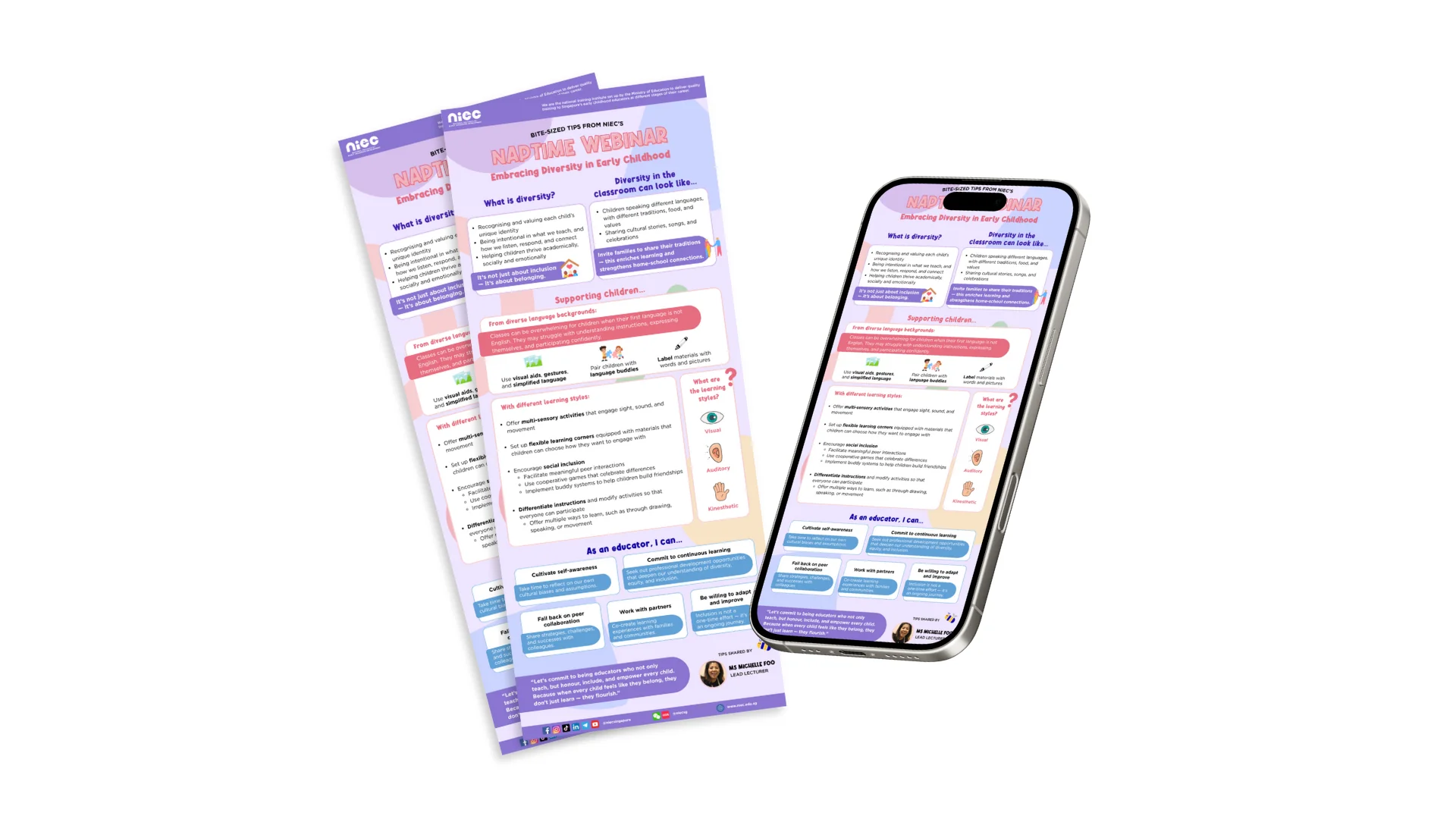
Keep these useful tips and tricks on hand — download the resources shared during the session here!


Learning Never Stops
NIEC offers a wide variety of Continuing Professional Development (CPD) courses for educators to enhance the skills and knowledge required to better support children’s learning and complement your curriculum in the preschool. Other courses on Special Needs and Inclusive Practice include:
- Effective Classroom Management & Behaviour Guidance for Inclusive Settings
- Supporting Children with Added Needs in Preschool Classroom Environment
- Integrating Inclusive Strategies Across Daily Activities
Head on over to our website to view more CPD courses on inclusivity and beyond!
Don’t Forget To Stay Connected With The NIEC Fraternity
Click on the ‘Join Mailing List’ button on the right and be the first to know about our upcoming workshops, webinars and more!
Join Us On Social Media Too!
Click on the ‘Join Mailing List’ button on the right and be the first to know about our upcoming workshops, webinars and more!
Stay up-to-date with expert tips from our faculty, event highlights, and other fun content for EC educators.
Follow us @NIECSingapore!