


Dear Educators,
Thank you for joining us at our first Naptime Webinar of 2026, “Babies and Screen Time”, on 23 January 2026! With Ms D.K. Gowri, Lead Lecturer at NIEC, we took a deep dive into the world of screen time — from what screentime means for infants, to its impacts on their early development, to strategies that can help reduce screen time in centres and at home.
Catch the highlights from the session, and revisit the points shared here!
Hear from NIEC’s Director and CEO Ms Geraldine See on the importance of continuous learning in these ever-changing times.
Learn to manage screen time for infants!
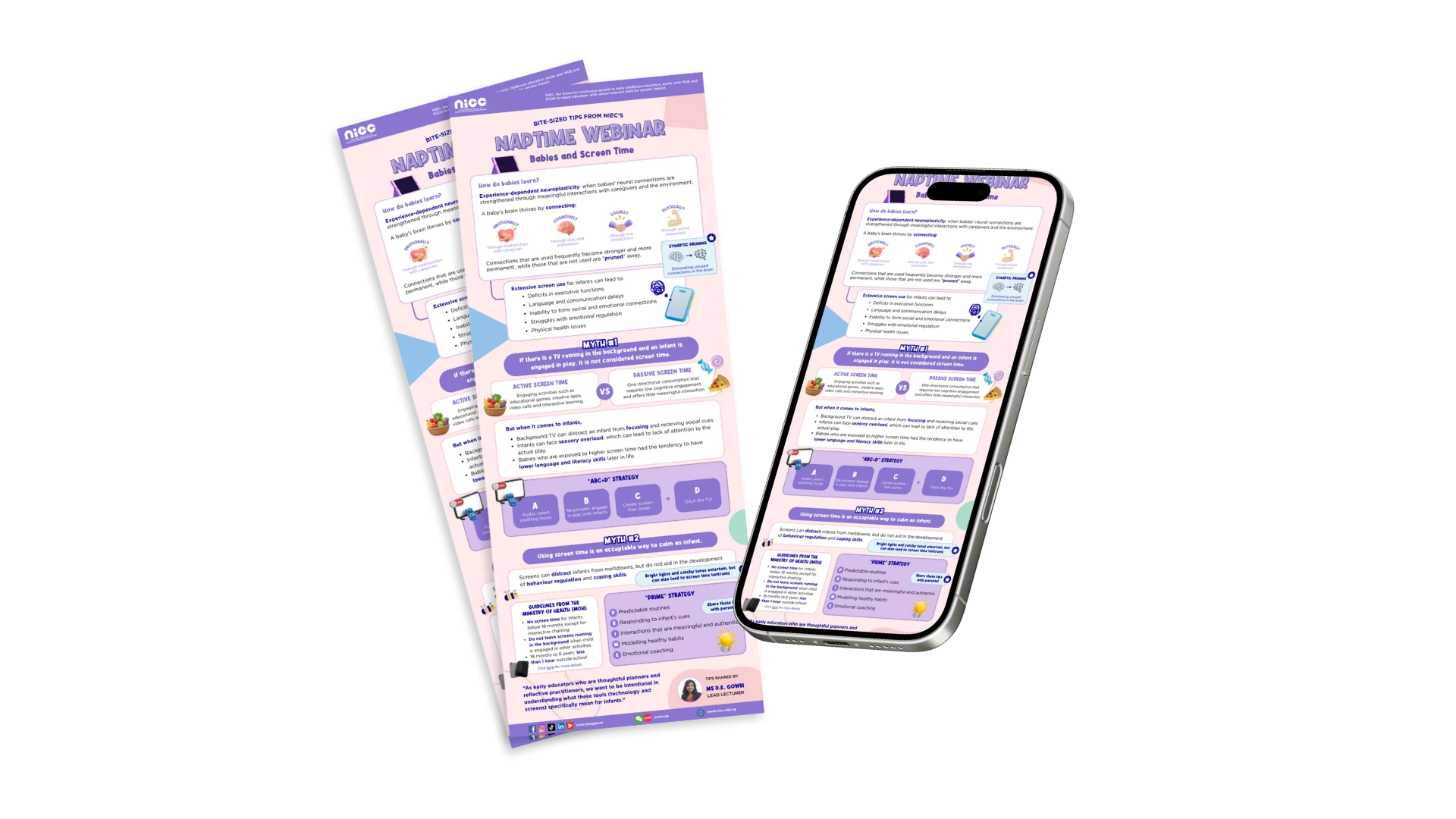
From birth to eighteen months, screen use in infants can pose detrimental effects to their social, emotional, physical, and cognitive development. Watch the video to learn more, and find out what strategies can help to encourage healthy habits for infants, especially in collaboration with parents.
Still have questions?
Read Ms Gowri’s answers to questions sent in during the Q&A session!
Firstly, I must say that I am very heartened with the fact that you recognised that for infants, consistency is key when it comes to establishing a sustainable outcome. For consistency, we need to ensure that first we recognise that we, as educators, are professional partners — as such, we have a shared responsibility in sharing our best practices with parents through the various strategies.
In sharing, start from where the infant is, and where the family is. Build trust through authentic conversations, and documentations on what worked in the centre. Try connecting through different platforms, such as informal conversations that are sensitive and two-way. This way, parents are more likely to follow through what they initiate and what they think they can do.
Sharing of resources is great, but can be overwhelming for some parents. So, start with strategies that work for you in the centre and be specific, by offering bite-sized tips, one thing at a time.
This is a classic example of a situation where screen is a “digital pacifier”. Firstly, this situation suggests that the family may be struggling with, or is uninformed about managing the infant. And that exactly, where we need to start —with the parents. When communicating with parents, try starting with the following:
- Acknowledge the Struggle: Validate that parenting is exhausting. The goal isn’t to be “perfect” but to gradually replace the digital tool with human connection. It is important to centre conversations around the infant and the screen rather than the family and what the family is not doing.
- The “Digital Numbing” Effect: Explain that videos don’t actually “calm” the brain; they often just distract or numb it, which can lead to even bigger meltdowns once the screen is turned off.
- Research and Findings: You may wish to share with parents on the guidelines and resources shared by the Ministry of Health (MOH), which also report findings on the detriments of screen time, such as slower language skills and attention spans. This could aid their understanding of the impact of screen time on their infants’ learning and development.
- Attention and Focus Issues: Infants exposed to more than two hours of screens daily are significantly more likely to struggle with attention. In the centres, this may manifest as a shorter attention span during “circle time” or difficulty engaging with 3D toys that don’t provide the same rapid visual feedback as a screen.
- Lastly, this is probably the most challenging one and one which you need to tackle sensitively and thoughtfully. The “Technoference” Effect: Behaviour is also affected by parental screen use. When parents are distracted by devices at home, infants receive fewer opportunities for conversational practice, leading to language delays that make it harder for them to communicate their needs to teachers.
It is both a mindset change and a lifestyle change. Try connecting parents with further resources in the community, such as expert insights from ECDA. Holding workshops for parents might also come in handy, though it is important to note that needs and strategies can be very different across differing age groups, such as toddlers or infants.
Here are some methods you can share with parents to help manage screen time at home:
- The “Slow Wean” Strategy: If the infant is highly dependent on screens, going “cold turkey” may be too stressful for the family. Suggest a gradual transition, like switch to audio-only. If they watch a specific show, try playing only the audio/music from it while the child plays with physical toys. This removes the visual “hook” while keeping the familiar sound.
- The 15-Minute Rule: Gradually reduce screen time by 10–15 minutes every few days, replacing that time with floor play or a book.
- Co-Viewing: If a screen must be used, the parent should sit with the infant and talk about what they see. This turns a passive habit into a social interaction, which is much better for brain development
- Lastly, document and share all the great things that we do in the centre — from messy play and sensory “antidotes” to outdoor play and reading books, give parents examples of what works for their infants in the centres. Instead of moving pixels, these real-world activities engage infants’ minds and bodies and support their development.
Earlier in the session, we shared that background TV counts as screen time, and it can distract infants from the play they’re engaging in. This is why as part of the ABC+D strategy shared, A stands for Audio, specifically a mindful selection of calming music. This happens in our centres, where we have a collection of music that we play with young children, which we believe has calming effect, or songs during pack-up time. This is fine — in fact, it can be a helpful first step in reducing screen time.
Like we mentioned earlier, it might be hard to immediately cut off all screen time, especially if their infants are already used to it. Here, replacing audio-visual stimulation with just audio can be a good start, to slowly wean off screen use.
However, when it comes to things like radio, with conversations, or things like podcasts — that kind of audio stimulation may supersede everything else that is happening in the infant’s presence. We really want infants to engage and really immerse so that they are very tuned-in with the activity or the play that they are engaging in.
At the end of the day, it’s about being mindful, and creating a space for infants to really focus on the play that they’re engaging in. Ideally, this means removing potential distractions, both visual and audio.
To answer this question, I would like to share a fun fact: infants cannot easily transfer 2D information from a screen to the 3D world. They will learn more about the concept of a “ball” by holding a real one for 30 seconds than by watching a video of one for 30 minutes.
When it comes to infants, we’re talking from birth to eighteen months, it is clear that screen time does more harm than good.


Learning Never Stops
NIEC offers a wide variety of Continuing Professional Development (CPD) courses that are designed to suit your schedule and professional needs — whether you’re looking to better understand the development of infants and toddlers, or new strategies to implement in your classroom, NIEC has the course for you.
Explore courses on Birth to Three here.
Don’t Forget To Stay Connected With The NIEC Fraternity
Click to join our mailing list, and be the first to know about our upcoming workshops, webinars and more!
Join Us On Social Media Too!
Stay up-to-date with expert tips from our faculty, event highlights, and other fun content for EC educators.
Follow us @NIECSingapore!