
Articles
No Screen Time for Infants? How ‘Digital Pacifiers’ Impact Development

Screen time has been hotly debated among childcare circles ever since watching TV became a common habit. While most parents intuitively understand that screen time can negatively impact their child’s development, articulating why that is the case is not always so easy.
But knowing the impact of screen time on infant brain development can help us better understand why we need to replace devices with real-world interactions in the first place, as well as how to effectively go about doing so. In this article, we explore effective strategies on how to reduce screen time in centres and at home with NIEC Lead Lecturer Ms D.K Gowri.
Is it ok for babies to watch TV?
As adults, we benefit greatly from the convenience that technology brings into our lives. It can therefore be hard to fathom why one would deprive children access to such powerful tools. However, it’s important to understand that babies are wired differently from adults. Because their young brains have not had the time to develop neural connectivity, babies rely on interactions with their environment to understand the world around them. This process is also known as experience-dependent neuroplasticity.
“Infants cannot easily transfer 2D information from a screen to the 3D world. They will learn more about the concept of a “ball” by holding a real one for 30 seconds than by watching a video of one for 30 minutes.”
Social interactions, for example, provide accompanying cues such as body language, spontaneous reactions, or even the look in one’s eyes that screens are incapable of offering. These cues stimulate an infant’s senses while helping them contextualise complex concepts and acquire language more effectively. Apart from knowledge acquisition, experience-based learning is also key to developing a child’s emotional regulatory system.
How screen time slows brain development
On the flipside, screens only provide visual and audio stimulations, leaving motor and executive brain networks idle. As time passes, the brain will begin synaptic pruning of unused neural connections, delaying speech development among infants. In extreme scenarios, the ability to express oneself can be absent altogether. Research shows that stunted brain development can also manifest in the form of health issues such as sleep deprivation or lifestyle-linked obesity, as well as attention-seeking or aggressive behaviour further down the road.
“High screen time, especially between infancy and two years of age, has been linked to lasting deficits in the executive functions of impulse control, focus, and emotional regulation.”
Myths about babies and screen time
Background TV does not count if a child is engaged in another activity
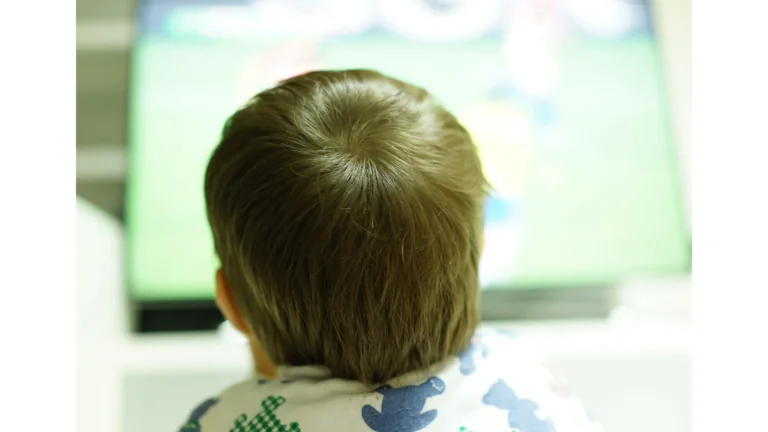
According to The American Academy of Paediatrics, screen time is defined as any time spent in front of a screen. Essentially, passive activities that require low engagement such as mindless scrolling or watching non-interactive videos are the junk food equivalents of entertainment. Even when played in the background, dramatic tones and sounds can contribute to sensory overload and distract them from actively engaging with their main activity.
Screen time is an acceptable way to calm an infant
We’ve all been there — the allure of the screen can seem like a simple way to put temper tantrums to rest. However, repeated use of external stimuli can prevent infants from developing their internal coping and sensory processing skills, creating a vicious cycle where they become reliant on the flickering lights and animated voices from digital media instead.
How parents can promote healthy screen time habits
MOH Guidance on Screen Use in Children
The Ministry of Health’s Guidance on Screen Use in Children provides clear guidelines that parents can abide by according to their child’s age:
- No screen time for infants below 18 months, except for the purposes of interactive chatting.
- Less than 1 hour after school for children aged 18 months to 6 years.
- Do not leave screens in the background when a child is engaged in other activities.
Tips to wean off screen time
An infant’s learning environment should always be curated with the purpose of helping them focus on the play they’re engaged in. This means removing both visual and audio distractions as much as possible.
However, cutting off all screen time when infants are already used to it can be a challenge. In such cases, replacing audio-visual stimulation with pure audio can help slowly wean off screen use. Additionally, selection of calming music during specific times such as pack-up time can help associate positive feelings with such activities.
Radios, podcasts, or any form of media with conversations are typically not encouraged as the audio stimulation may interfere with the infant’s ability to fully immerse and engage with what’s happening in front of them.

How educators can encourage consistent screen time habits outside of school
Collaborating to build conducive at-home environments
Outside of school, infants spend the majority of time with their families, making parents the partners of educators with a shared responsibility in their child’s learning and development. Documenting what worked in the centre and communicating that to parents can go a long way in not just building trust, but also ensuring that healthy habits continue to be practiced after school hours.
For example, not all parents may understand how screen time numbs and distracts the brain instead of calming it. In fact, parents themselves may also be distracted by devices, leading to fewer opportunities for infants to practice conversations. Educators may seek opportunities to understand a child’s learning environment at home and gently provide tips and pointers to nudge parents in the right direction.
“Excessive screen time at home may manifest during centre time in the form of short attention spans, particularly when 3D toys or in-person interactions do not provide the same rapid visual feedback that infants are used to seeing on screen.”
That said, it is important to validate the struggle that parents face and remind them how it’s not necessary to be perfect, but to gradually work towards replacing digital tools with the human connection.
Tools to keep on hand
Of course, every family dynamic is fluid, and it is not always practical to stick to these rules without flexibility. Adapting the PRIME framework shared by Ms Gowri according to each family’s circumstances can help a child build healthy habits with their devices.
- Predictable routines help infants develop a sense of control over their environment, which aids in self-regulation.
- Responding to infant cues to help them develop social skills.
- Interactions should be meaningful and authentic, rather than virtual.
- Modelling healthy habits by introducing literacy materials through traditional books or toys, rather than screens.
- Emotional coaching through the labelling of feelings.
Download our Babies and Screen Time digital handout for a bite-sized summary of this article, or explore the Birth to Three courses to learn more about early years development.
INTRODUCING OUR FACULTY
 As Lead Lecturer of NIEC (City), Ms D.K. Gowri Danakodi has contributed significantly to curriculum writing and training module design of the Child Development and Observation modules. She holds a Master’s Degree in Education (Early Childhood) from NIE, NTUC and is an advocate of multicultural education while also contributing to the training of KidSTART practitioners.
Catch highlights and revisit points shared during Ms. Gowri’s Naptime Webinar, “Babies and Screen Time”.