
Articles
Funding & Salary Support for Mid-Career Switch into Early Childhood Education
For many mid-career professionals, the biggest barrier to changing careers is not motivation, but financial stability. While preschool teacher salaries have strengthened in recent years, individuals considering a transition into the sector must still balance training commitments with ongoing income and family responsibilities.
The good news is that Singapore offers training funding and employment support options to ease this transition. These include SkillsFuture-eligible courses and company-sponsored programmes that provide training allowances or salary support for aspiring early childhood educators. Understanding the available funding options will help mid-career switchers plan a financially sustainable transition into their new sector as a trained and certified early childhood educator.
How to fund your early childhood educator training
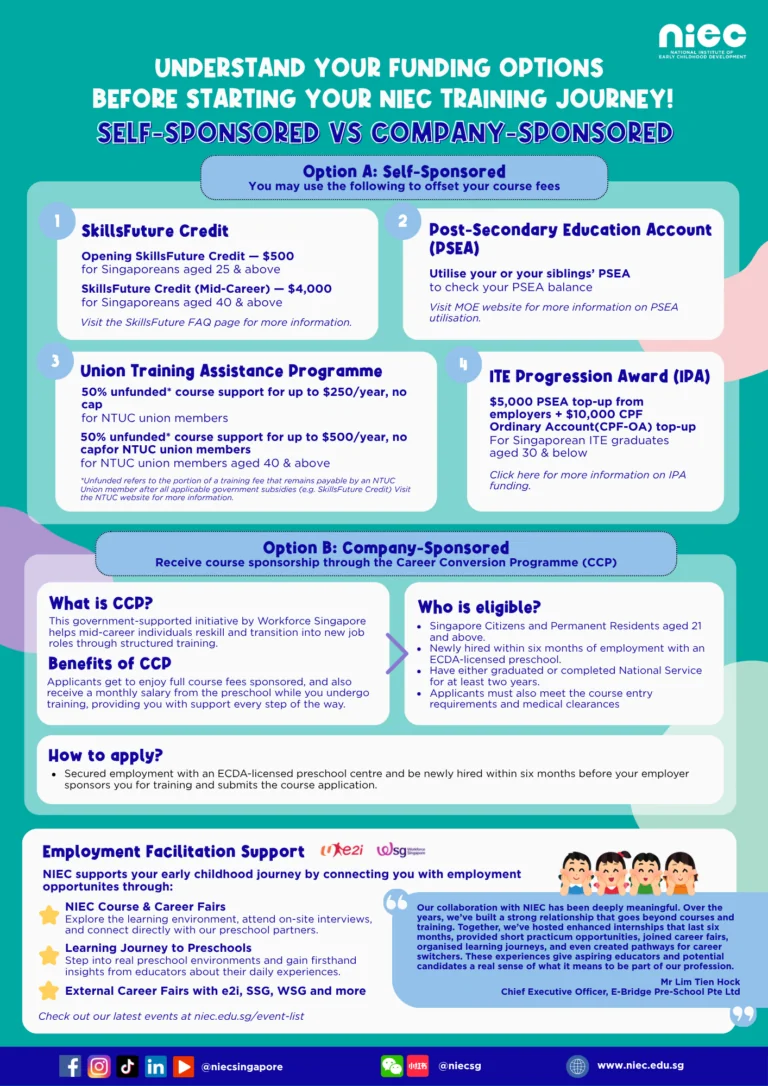
There are two main ways to fund your early childhood educator training as a mid-career professional. The self-sponsored route offers greater flexibility and the option to offset tuition fees with SkillsFuture credit. On the other hand, company-sponsored pathways such as the Career Conversion Programme (CCP) cover a larger portion of training fees but may require applicants to secure employment with ECDA-licensed centres prior or commit to work placements.
Self-sponsored funding options
Self-sponsored funding options allow aspiring educators to take up training in early childhood education with zero upfront cost. For example, Singapore Citizens or Permanent Residents looking to take up the Advanced Certificate in Early Years (ACEY) course, the course fee would be $1,242.60 after MOE subsidy, this amount can then be fully covered by SkillsFuture Credit if available.
Additional self-funding options are also available as follows:
- SkillsFuture: The Opening SkillsFuture Credit is given to all Singaporeans aged 25 and above and does not expire. Individuals aged 40 and above (as of 1 May 2024) are eligible for an additional SkillsFuture Credit (Mid-Career) of $4,000 under the SkillsFuture Level Up Programme. You can use both Opening SkillsFuture Credit and the SkillsFuture Credit (Mid-Career), where applicable, for eligible NIEC courses. Note that SkillsFuture Credit claims will only be accepted for registrations made via the MySkillsFuture Portal, and must be submitted within 60 days before the course start date.
- Post-Secondary Education Account (PSEA): Singaporean part-time diploma, post-diploma and certificate students or students with Singaporean siblings may use their respective PSEA balances to offset course fee payments. Usage category should be filed under SSG-PDEV. More details can be found here.
- Union Training Assistance Programme (UTAP): NTUC members can enjoy 50% unfunded course fee support capped at $250 per year for UTAP-supported NIEC courses. NTUC members aged 40 and above can receive funding support of up to $500 per individual per year, capped at 50% of unfunded course fees. More details can be found here.
- Institute of Technical Education (ITE) Progression Award (IPA): Singaporean ITE graduates aged 30 and below who pursue a diploma qualification issued by an MOE-funded institution will be eligible for $5,000 PSEA top-up from their employers upon enrolment and $10,000 of CPF-OA top-up upon graduation. More details can be found here.
Please note that the above funding information and course fees are as of May 2026 and are subject to change.
Company sponsored funding options
The CCP for Preschool Educators programme is open to company-sponsored applicants who are Singapore Citizens (SC) or Permanent Residents (PR) aged 21 years and above. Further details on qualifying criteria may be found on the official programme website.
Successful applicants offered a minimum 12-month employment contract with a fixed monthly salary of S$2,400 or more for a CCP-related role may receive salary support throughout their training. Workforce Singapore (WSG) provides this support via the employer at two different rates:
- Standard Rate: For SCs and PRs under 40, up to 70% of monthly salary (capped at S$5,000).
- Enhanced Rate: For SCs and PRs aged 40 and above, or those unemployed and actively seeking work for at least six months, up to 90% of monthly salary (capped at S$7,500).
Please note that the above funding information and course fees are as of May 2026 and are subject to change.
Employment facilitation support for mid-career professionals
NIEC offers career-matching support even before you begin your early childhood education training courses. That’s why NIEC regularly hosts course and career fairs for aspiring early childhood educators to connect with potential employers or even receive on-site interview opportunities. In addition, interested applicants can also gain insight into what it’s like to work as an early childhood educator through in-person learning journeys at various ECDA-licensed centres.
In addition, mid-career professionals can tap into career matching and guidance services offered by government agencies. This includes skills assessment and job application support by the Employment and Employability Institute (e2i), as well as virtual and in-person career counselling by WSG.
View the image in PDF here for more detailed information and links to additional resources.
Applying for NIEC early childhood course subsidies
To make the most of available subsidies and training allowances, start by reviewing the entry requirements for your chosen course and understanding the conditions for each funding option. If you’re considering company sponsorship, check intake dates and application deadlines to ensure you don’t miss out.
For instance, applicants to the Career Conversion Programme (CCP) must first secure sponsorship from an ECDA-licensed centre, which may include fulfilling an employment bond. Once employed, you can apply for your NIEC course within six months to receive tuition sponsorship in addition to salary support.
Every mid-career switch is unique, so don’t hesitate to reach out to NIEC for guidance on courses, funding options, or intake schedules that best suit your situation.