


Dear Educators,
Thank you for joining us at our Naptime Webinar of 2026, “Nurturing the Educator’s Wellbeing”, on 26 May 2026! With Dr Kok Siat Yeow, Deputy Director (Academic) at NIEC, we took a deep dive into the world of educator wellbeing — from why personal mastery matters, to the practical strategies you can embed into your daily routines to support yourself and the people around you.
Catch the highlights from the session, and revisit the points shared here!
Hear from NIEC’s Director and CEO Ms Geraldine See on the importance of educator wellbeing in providing high-quality early childhood education.
Learn to support your wellbeing as an educator!
What is educator wellbeing? Why is it important, and where can you start? Watch the video to find out!
Still have questions?
Read Dr Kok‘s answers to questions sent in during the Q&A session!
This is a very relevant question. Firstly, we all need a community that we can fall back on. This could be your family, your friends, your religious groups, your volunteer groups, and the likes. They are your safety net for your mental and your physical well-being, because as human beings, we are meant to connect and coexist with one another to support each other in our journey through life.
One strategy to share is to take time for yourself. Do something that you enjoy — exercise, cooking, picking up a hobby. Furthermore, you can practice tuning into your body, the quick “hand over your heart” exercise, and deep breathing exercises. This will help you feel a release of pressure and feel a little bit better.
It’s also important to set boundary for yourself and protect your personal time. Because I know early childhood educators, have such big hearts and you just want to serve and help because that’s who you are. But please take care of yourself. Make sure you set boundary for yourself, protect your personal time. Always remember that you have the right to say no, and do not be afraid to do so.
Another strategy is focus on what you can influence. There are many things that are beyond us, so don’t sweat because you can’t control. But on the other hand, you have many things that you can control. You can influence the children, you can influence the parents, you can help them to help the children to develop. You can support your colleagues. It helps to focus on what you can do.
I know early childhood educators, you are resilient, you are resourceful, and you are default problem solvers. I encourage you to channel your energy to contribute to make things better — what is it that you can do? How can you contribute so that it becomes meaningful and satisfying for you?
Like a participant mentioned during the session, be present and listen. Sometimes all that people need is to have someone to listen to them. They might have the solutions in their mind, but just need someone to be present and listen. Then, you can render the necessary support by stepping up and asking questions like “can I help you?”
For those of you who are in positions of leadership, I find that staff appreciates a certain level of flexibility when they are in the midst of crisis management. It’s also important to put processes and systems in place, and streamline processes and systems so that we can make the work better for the staff.
It’s important to remember you can share resources with your peers. Earlier, I shared about mindline@work. There are plenty of resources in the community that we can reach out to, to support yourself, your wellbeing as well as to support one another.
That’s a great question. Listening to them, spending time with them, team bonding, these are well and good — but as leaders, we need to know what the real issues and the pain points are. That means able to identify the issues that are bothering staff. What are some of their perspectives? What are some of their pain points?
It’s also important for us to look at what are the processes that we can streamline — are there processes that can be less cumbersome? Are there systems in place to help the staff? Of course, listening, and going for team bonding are important. But we also need to put systems and processes in place. I would recommend getting the staff to co-construct with you. What are some of the solutions that the staff can suggest? How can we brainstorm and co-construct together to make things better? As the leader of the centre, you must decide at the end of the day, to get feedback, to construct a better working environment for everyone.
I was a teacher and a principal in the centre quite some time ago. But people have changed, society has changed, and issues are more complex now. If we use our own lens to relate with the children, then we may not be relating with them. It’s important to examine our mindset — just because we grew up in a certain way, it doesn’t mean that the children nowadays will accept how we relate with them. It’s about knowing the children, understanding them, and also be reflective of our own practices. Ask questions like “does this strategy work?” “Why it doesn’t work?”
For many of you, you do have children with added needs in your classroom, and it can be quite challenging. I recommend going for classes to better equip yourselves, and talking to people so that you can share strategies to manage the children better.
The other one is about reflecting on your mindset. What worked for you may not work for the children now. We need to be reflective, and we need to ask ourselves — how else can I do it differently? Who can I talk to? How can I get help?
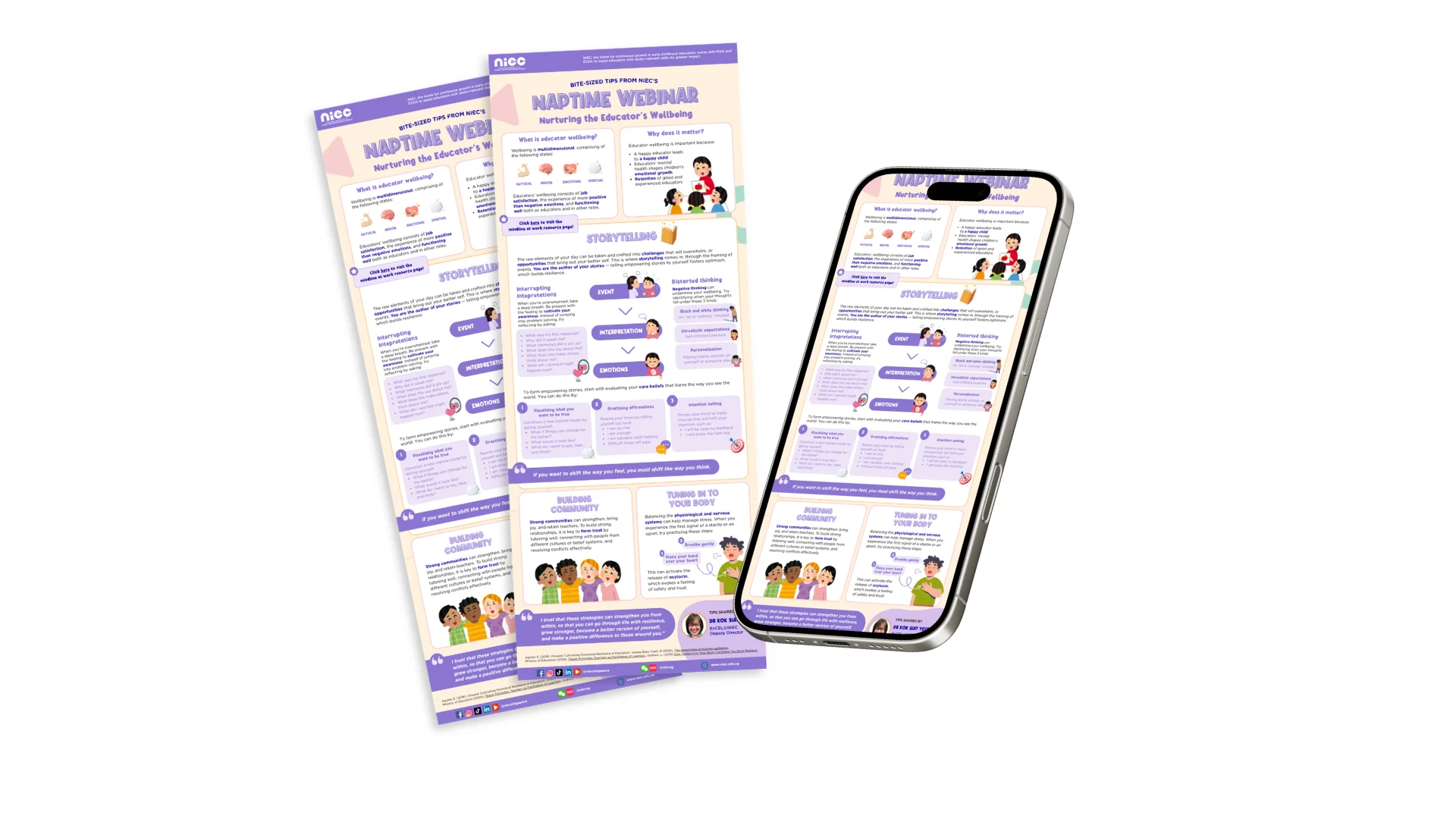
Keep these useful tips and tricks on hand — download the resources shared during the session here, and visit the mindline@work resource page.
Test your memory and revisit the Kahoot quiz here!


Learning Never Stops
NIEC offers a wide variety of Continuing Professional Development (CPD) courses that are designed to suit your schedule and professional needs — whether you’re looking to learn how to care for your wellbeing in the early childhood context, or pick up new strategies to implement in your classroom, NIEC has the course for you.
Explore courses on Personal Mastery here.
Don’t Forget To Stay Connected With The NIEC Fraternity
Click to join our mailing list, and be the first to know about our upcoming workshops, webinars and more!
Join Us On Social Media Too!
Stay up-to-date with expert tips from our faculty, event highlights, and other fun content for EC educators.
Follow us @NIECSingapore!